NHS neurodevelopmental diagnosis process
The diagnosis process from the NHS Neurodevelopment team has evolved over the years and the waiting list is currently sitting at 4-5 years. Some parents have experienced shorter waiting times by being referred by CAMHS to the Learning Disability team in Motherwell
The section below sets out the process followed as shared by some of our parents to help prepare you for the process. It may be helpful to keep a diary in advance of the appointment, such as of behaviours or sleeping patterns.
Some parents are surprised by the diagnosis – such as they are expecting an autism diagnosis but receive an intellectual disability diagnosis. There may also be multiple diagnoses given, such as for autism and ADHD.
The Neurodevelopment team are currently trialling two pilots to help reduce their waiting list. The first is targeting pupils in P6 who are on a neurodivergent pathway with the hope of a diagnosis being given before they leave primary school and therefore helping their transition to high school with appropriate supports in place.
The second is doing ‘whole school’ assessments which involves spending two weeks in a school and carrying out assessments of all children in that school on the waiting list. This allows them to have multiple observations of children while they are in the school to aid with the diagnosis.
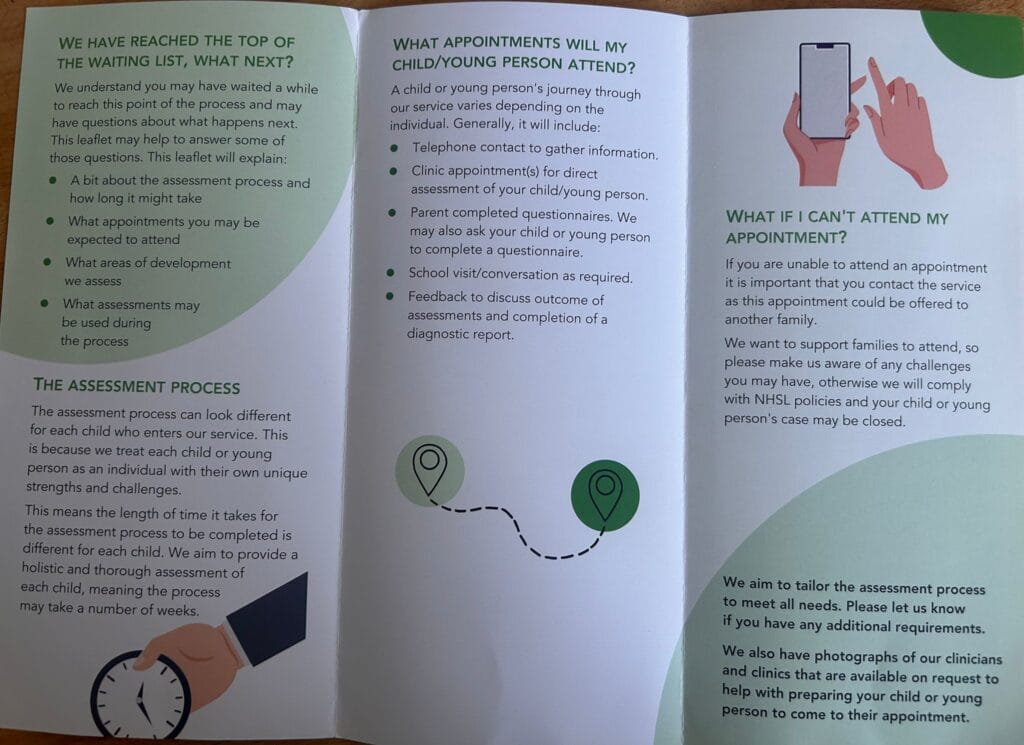
As a result the diagnosis process may change, but the steps below are the recent approach used by the Neurodevelopment team. The process takes around 4 months:
- You will be asked to complete a questionnaire based on the suspected diagnosis, for autism this is the Fife neurodevelopmental questionnaire or F-NDQ. It’s a comprehensive form covering multiple topics like family history, pregnancy and birth, medical and educational history, daily living skills, sensory processing etc. It’s a hard form to fill in so it is worth taking your time and not trying to do it all in one day. A copy for information can be found here: https://moodcafe.co.uk/media/5kadpaxa/f-ndq-digital-child-form-version-2.pdf. For intellectual disability the clinic will use something like the Vineland adaptive behaviour assessment, an example is here: https://www.carepatron.com/templates/vineland-adaptive-behavior-scale#app-chapter-one
- There will then be a call with a member of the neurodevelopmental team to walk through the form. They may ask you to give more information on some of the responses or answer additional questions.
- They will then arrange to see your child. This is normally in a few different settings such as at school, at home and in their clinic to see how they interact and play, and do some specific tasks to see if they can do things like match colours, recognise numbers etc. At school they will speak to the teachers to get their insight. The team are experienced in dealing with children who are non-verbal and/or do not respond well to verbal instructions so may use something like the ICD-11 behavioural indicators (https://www.who.int/publications/i/item/9789240077263 to help with the diagnosis.
- The team may wish follow up visits or to come back to the diagnosis process if there is not enough evidence to give a diagnosis